Interpreting Fitness Tracker Stress Metrics
3rd Mar•8 min read
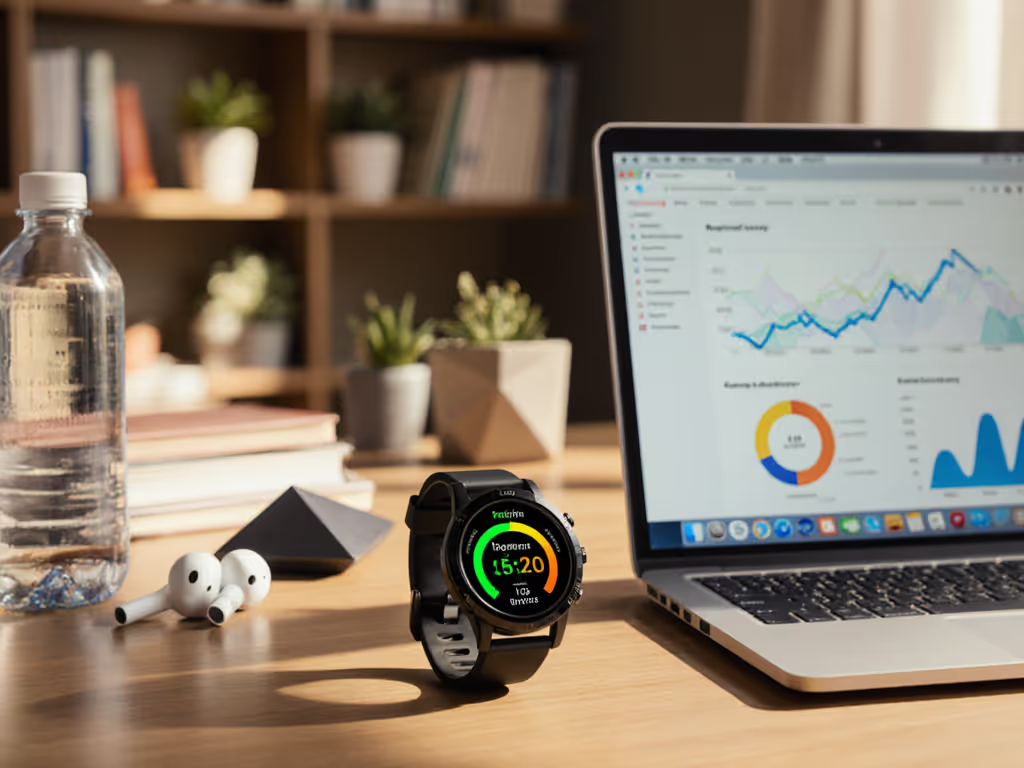
Fitness tracker readiness metrics promise something seductive: a single number each morning that tells you whether your body is ready to crush a workout or needs rest. But that number is a composite calculation drawn from multiple sensors, weighted by algorithms you can't see, and defined differently across every brand that makes one. Before you trust it to guide your training (or your wallet), you need to understand what's actually happening under the hood.
I learned this the hard way. Years ago, a fitness app I'd relied on for sleep tracking pivoted to a subscription model and locked historical exports behind a paywall. Two years of sleep data I'd generated became hostage to a policy change I never agreed to. That week, I mapped every tracker's export formats, retention defaults, and deletion paths. If I can't leave with my data intact, I don't enter. That lesson applies directly to readiness scores: if the algorithm is opaque and the data isn't portable, you're renting insights, not owning them.
Let's decode what these scores really are, why they matter less than you think, and how to use them without becoming enslaved to a red-green dashboard.
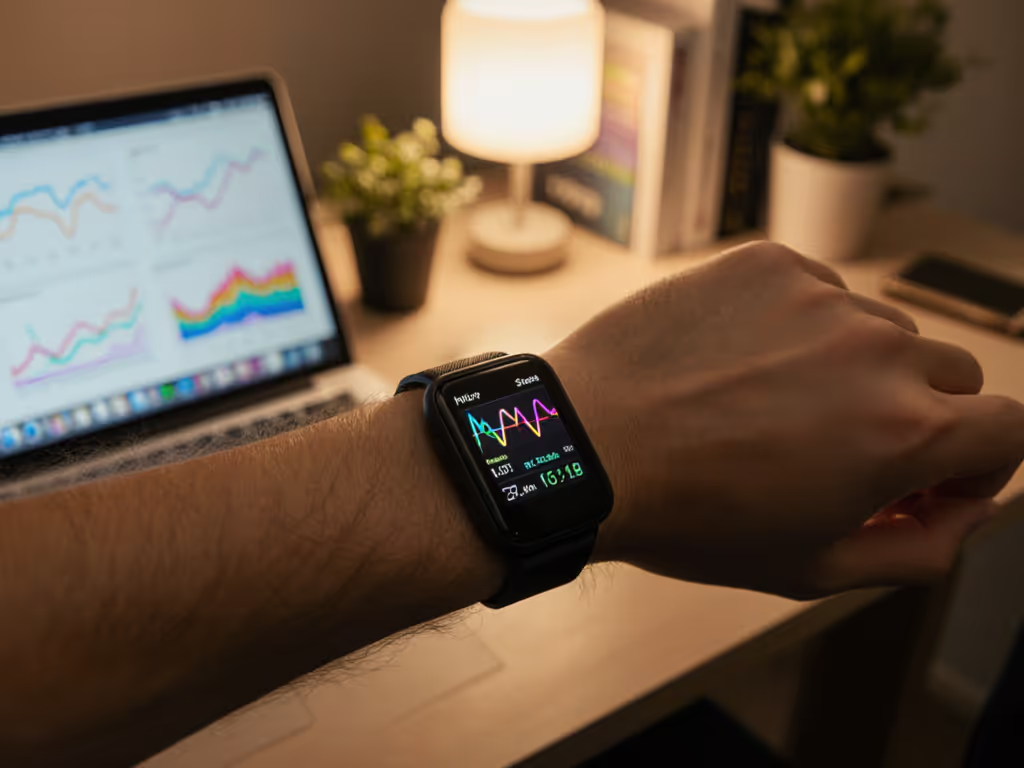
Readiness, recovery, strain, body battery, resilience (different companies use different names), but they're all the same concept: a composite health score that synthesizes multiple biometric inputs into a single daily number[2]. For a clear breakdown of how brands name and calculate these numbers, see our recovery and readiness metrics guide. The typical inputs are resting heart rate, heart rate variability (HRV), sleep duration and quality, and physical activity or training load. Some brands add respiratory rate, skin temperature, or blood oxygen saturation[2].
The appeal is obvious. You wake up, glance at your wrist, and get a straightforward answer: Am I ready to train hard today, or should I rest?
The problem is more subtle. Each brand calculates that score differently, uses different time windows (some use 7 days, others 14 or 28), weights recent data with different emphasis, and defines "normal" and "baseline" on its own terms[2]. This means a readiness score of 75 on Brand A tells you almost nothing about what 75 means on Brand B (or even what your own score meant yesterday if the algorithm was tweaked in a firmware update)[2].
Renting data is still paying. Without transparency into the algorithm, you're paying attention (and often a subscription) to a number you can't truly own or validate.
The metrics that go into readiness scores are physiologically sound in isolation. Heart rate variability reflects your nervous system's adaptive capacity[2]. Sleep quality and duration are foundational to recovery[2]. Training load captures the cumulative stress you've placed on your body[2].
But here's where the science gets messy: these signals are not independent[2]. They're interconnected. If you had a rough night's sleep, your resting heart rate likely rises and your HRV drops, all in response to the same underlying cause. When an algorithm combines them into a single score without accounting for this relationship, it can penalize you multiple times for the same issue[2].
This problem is called multicollinearity, and it's a real flaw in how composite scores are built[2]. The result: your readiness score might plummet not because your body is actually under severe stress, but because the algorithm is amplifying the same signal (poor sleep) from three different angles[2]. It creates the illusion of precision while potentially overstating your need to rest.
Meanwhile, because companies don't publish the details of their calculations, it's impossible to know exactly how much weight each input carries, how outliers are handled, or whether the baseline they're comparing you to makes sense for your body[2].
No. But they work best when you stop treating them as gospel.
A single low score on one day is not a reason to cancel your workout if you feel good. Your perception of how your body feels matters. A lot[3]. That readiness number should be a data point, not a command.
Where readiness scores become genuinely useful is when you view them as patterns over time, not isolated daily guidance[3]. If your recovery scores are consistently low for several days and you notice you're feeling sluggish or irritable across those same days, that's a signal worth heeding[3]. Conversely, if your average readiness trends upward over weeks or months, it's evidence that your training and lifestyle changes are actually supporting recovery, which is far more meaningful than chasing green and red scores[3].
The analogy is a financial ledger. One day of low spending doesn't mean your budget is broken. But a three-month trend of overspending signals a real problem worth addressing.
If you're going to trust a readiness score, focus on the inputs rather than the output.
Heart rate and HRV: A lower resting heart rate (ideally under 85 bpm at rest) generally indicates cardiovascular fitness and recovery[1]. HRV (the variation in time between heartbeats) is a proxy for how adaptable your nervous system is. Higher HRV often suggests you're well-recovered and ready for stress (whether that's a hard workout or a demanding day)[2].
Sleep: Duration and consistency matter far more than your tracker's stage breakdowns (which are estimates, not lab-grade measurements). For how wearables estimate sleep stages and where they fall short, read our sleep tracking science explainer. If you're regularly getting 7-9 hours and the tracker notes decent continuity, that's a meaningful signal[2].
Activity and training load: Your recent workout volume and intensity set context for how much additional stress your body can handle[2].
When a readiness score pulls from these inputs, it has a reasonable foundation. When it adds obscure metrics or claims to account for factors like alcohol consumption without transparency, treat it with skepticism.
Use it as a conversation starter with your body, not a final authority. To turn these signals into sustainable progress, follow our step-by-step training with tracker data framework.
If your score says you're ready but you feel exhausted, listen to yourself. Trackers miss context. You might be fighting off an infection, dealing with stress, or simply need a mental break.
If your score is low but you feel good, a light workout is fine. Readiness scores often err conservative, especially if the algorithm is double-counting poor sleep across multiple metrics[2].
If your score is consistently low and matches how you feel, that's worth investigating. Are you sleeping enough? Have you ramped up training too quickly? Is stress or illness affecting recovery? These are the real questions, not whether the number is 42 or 51.
Track the trend, not the daily number. Over a month or quarter, does your readiness improve or decline? Does it correlate with how you actually feel? If yes, the score is working as a useful pattern-matching tool. If your readiness is green but you're burning out, or red when you feel strong, the algorithm isn't calibrated for your body.
Most readiness scores live behind a proprietary app and a subscription paywall (or the threat of one). Before you commit, compare the real costs and locked features in our fitness tracker subscriptions guide. You generate the data (your heart, sleep, movement), but you don't control the algorithm, the export format, or whether the company will keep the feature free or charge for it later.
Before you rely on a readiness score as part of your training decision-making, ask yourself: Can I export this data in a portable format? Can I access the historical scores even if I cancel my subscription? What happens to my data if the company pivots or shuts down? If the answer to any of those questions is murky, the convenience of a daily score might not be worth the lock-in cost.
Fitness tracker readiness metrics are useful tools for spotting patterns in your recovery, but they're not the oracle they're marketed to be. They're built from solid inputs (heart rate, HRV, sleep, activity), but combined through algorithms that aren't standardized across brands, aren't fully transparent, and can double-count the same issue across multiple metrics[2].
Use readiness scores as a contextual health metric that informs, not dictates, your adaptive training planning. A low score combined with how you actually feel is a signal to rest. A high score that conflicts with your body's signals means trust yourself over the number.
Moreover, scrutinize the readiness score accuracy claims. Ask whether the data is portable, whether the calculation is transparent, and whether you'll still own your data if you change platforms. The score is only as valuable as the freedom you have to walk away from it.
Own your data, or someone else owns your decisions. Make sure the tracker you choose (and the readiness score it offers) serves your autonomy, not the other way around.