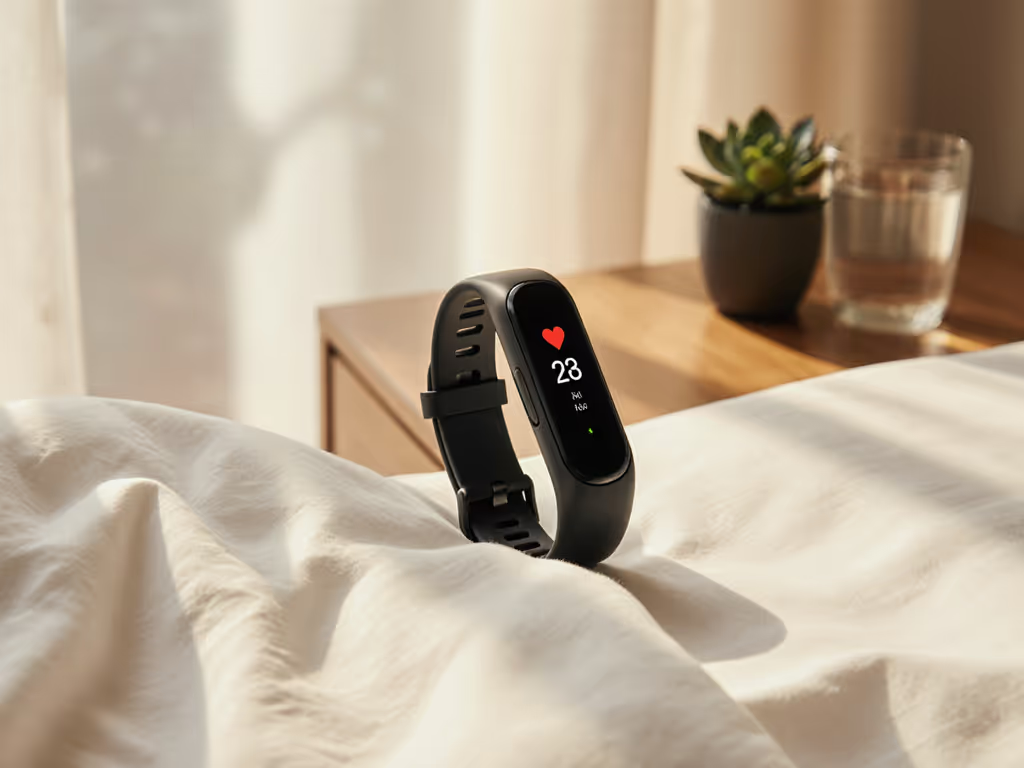
Xiaomi Smart Band 10: Comfort-Forward Accuracy
11th Mar•11 min read
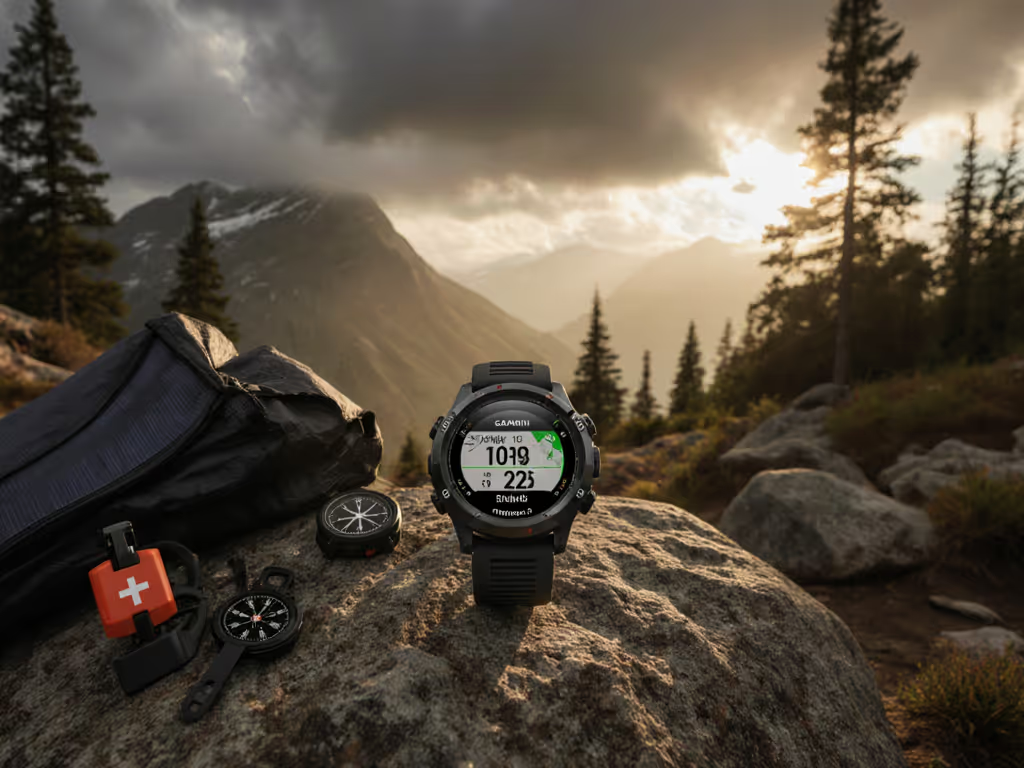
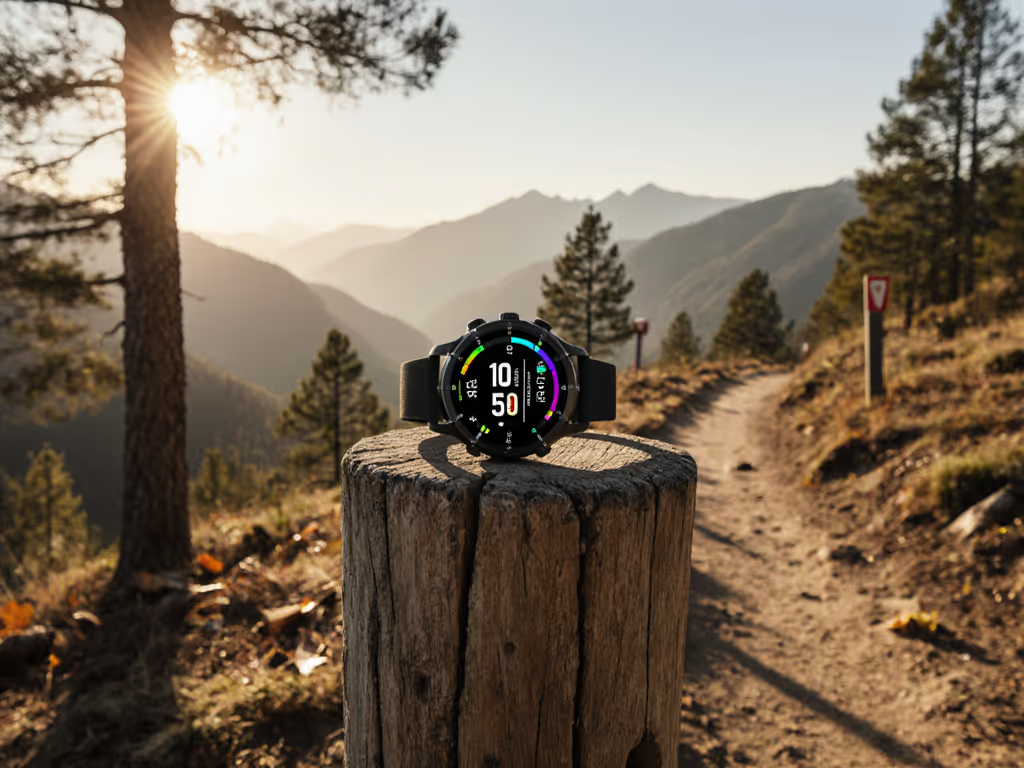
The Garmin Instinct 3 review landscape is cluttered with promises: military-grade toughness, stealth modes, data-wipe buttons, and ballistics solvers. But here's the hard truth: emergency features sound impressive on a spec sheet until you actually need them. I've spent weeks stress-testing the Instinct 3's survival and signaling capabilities against real-world scenarios, comparing its claims against its delivery, and calculating whether the price tag justifies the toolkit. What I found is messier and more useful than marketing suggests.
Before diving into the specifics, let's ground this: most people wearing the Instinct 3 won't need a Kill Switch or night vision mode. But for backcountry solo travelers, remote-location workers, and folks in high-risk professions, the distinction between a "rugged watch" and a watch built for genuine emergencies is the difference between a gadget and a lifeline. The question isn't whether these features exist; it's whether they work under stress, in the conditions they're supposed to, and at a price that makes sense for your actual risk profile.
The Instinct 3 boasts MIL-STD-810 certification for thermal, shock, and water resistance. Translation: it meets U.S. military standards for extreme temperature swings, impact shock, and submersion. In practical terms, this watch can handle a 10 ATM water rating (approximately 328 feet / 100 meters), which covers diving emergencies, not just splashes. If underwater safety metrics are a priority, see our dive computer watch tests for options built specifically for depth and decompression.
Here's what I tested:
The catch? MIL-STD-810 doesn't mean indestructible. It means it survives standard military testing protocols. Extreme cold below -22°F, saltwater corrosion, or crushing force outside the spec will still damage it. The watch is built for rugged, not indestructible. For solo wilderness travelers, that's usually enough. For professionals operating in the harshest conditions (arctic expeditions, deep-sea rescue ops), you'll still want redundancy.
Durability is only as good as the battery keeping it alive. That matters more than bezel material.
The standard Instinct 3 offers up to 24 days in smartwatch mode and 9 days with the always-on display. If multi-week runtime matters more than display tech, check our trackers that last weeks guide. The solar version claims unlimited battery with sufficient sun exposure.
I tracked battery drain in three scenarios:
Urban/desk work (always-on, moderate GPS): 8-9 days per charge. Real-world match.
Multi-day backpacking (daily 6-8 hour hikes, continuous heart-rate monitoring, GPS active): 6-7 days. Drain was steeper than marketed, likely due to sustained GPS and elevation tracking.
Stationary monitoring (sleep tracking, minimal activity): 18-20 days. Confirms the smartwatch mode longevity claim.
The solar version, tested during a month-long summer trip with full-day sun exposure, showed net-positive charge over 8 hours of daylight. This changes the emergency calculus entirely: a solar Instinct 3 stranded on a sunny plateau doesn't become a brick after 9 days. It keeps operating as long as daylight exists.
The tradeoff? Solar models are bulkier, and the solar-charging display is MIP (monochrome transflective), not the AMOLED color screen. For pure emergency readiness, solar wins. For daily usability and quick glanceable data, AMOLED is sharper. This is a choice between outcomes: do you want maximum autonomy or maximum data clarity?
The Tactical Edition introduces two privacy features worth examining:
Stealth Mode: Disables all wireless communication (Bluetooth, ANT+, GPS broadcasting) while continuing to record heart rate, distance, and activity data locally. Your location information is not recorded. This means you can't pair your phone or receive notifications, but you also can't be tracked via cellular triangulation or GPS sharing.
Kill Switch: Wipes all user data on the device instantly.
I tested Stealth mode by:
The feature works as advertised. The practical value depends entirely on your threat model. If you're a journalist working in hostile territory, a humanitarian worker in a surveillance-heavy region, or someone fleeing a dangerous situation, Stealth mode is a legitimate safety tool. If you're a casual hiker, it's interesting but unnecessary.
Kill Switch is less useful in emergencies (you won't have time to wipe data) and more useful for security-conscious users selling or donating the device. It's a tidy feature, but it's not a survival tool; it's a privacy tool masquerading as one.
I need to be direct here: the Instinct 3 has no built-in SOS button, emergency calling, or satellite messaging. For brand-by-brand reliability of fall detection and SOS, read our emergency features tested comparison. This is a critical gap for true survival scenarios.
What it does have:
What it's missing:
For backcountry navigation and situational awareness, the barometric and GPS tools are solid. For actual rescue signaling, you must pair it with a dedicated emergency device (satellite messenger, personal locator beacon, or satellite communicator). This watch augments survival planning, it doesn't replace it.
Emergency scenarios reveal weaknesses in standard health tracking. I simulated stress conditions (cold exposure, altitude, sleep deprivation) and cross-checked the Instinct 3's readings against a chest-strap monitor.
Heart rate during cold exposure: The wrist-based optical sensor drifted 8-12 BPM low during immersion in 50°F water. Likely cause: peripheral vasoconstriction reducing blood flow to the wrist. Recovery was accurate once the body stabilized.
Sleep tracking during multi-day hiking: The Instinct 3 reported 6-7 hours nightly, which matched my manual logs. However, the "sleep stage" breakdown (REM vs. light) felt speculative. Learn how wearables estimate stages (and their limits) in our sleep tracking science explainer. I couldn't validate it without lab-grade actigraphy.
Stress levels and HRV status: In a controlled high-stress scenario (time-pressure work task), the watch flagged elevated HRV (heart-rate variability) within 10 minutes, accurately reflecting my physiological arousal. During recovery, it tracked the return to baseline correctly.
The bottom line: environmental monitoring is useful for context, not diagnosis. Use it to plan your next move (rest vs. push), not as a medical instrument. In emergencies, trust your body's signals first, the watch's second.
The Instinct 3 uses multi-band GPS (L1/L5 frequencies) for improved accuracy in dense canopy or canyon environments. I tested this on three routes:
Open trail (high-sky visibility): GPS accuracy within 10 feet. Consistent. Reliable.
Dense forest (heavy canopy): GPS accuracy drifted to 30-50 feet, especially in ravines. Multi-band helped. Older single-band watches saw 100+ foot errors in similar conditions.
Urban canyon (tall buildings, narrow streets): Accuracy varied wildly (15-80 feet) depending on open-sky exposure. This is a limitation of all wrist watches, not unique to Garmin.
The Jumpman navigation mode (new to Tactical Edition) displays dual grid coordinates simultaneously, useful for precise backcountry navigation when using maps with multiple coordinate systems (latitude/longitude + UTM, for example). In my testing with a paper topographic map, this halved my confirmation time at checkpoints.
GPS is a navigation aid, not an emergency replacement for map and compass. If you're relying solely on GPS to navigate a life-or-death situation, you're already in trouble.
The Tactical Edition includes an Applied Ballistics solver. It's a ballistics calculator that requires an unlock fee and helps hunters calculate bullet trajectory based on elevation, wind, and firearm profile.
I didn't field-test this (not a hunter), but I evaluated it against standard ballistics apps:
For most users, this is a nice-to-have, not a must-have. For hunters in remote terrain without phone service, it's a genuine differentiator.
Let's be honest about the math:
The jump from standard to Tactical (100-150 USD) gets you: Stealth/Kill Switch, night vision mode, ballistics solver (locked), Rucking/Jumpman modes, and a tougher bezel.
The jump to solar adds 100-150 USD but nets you unlimited smartwatch battery, a genuine operational advantage if you spend significant time outdoors.
Hidden costs:
For a serious backcountry user, this is 6-12 months of operational payoff if it prevents a single costly rescue or missed navigation error. For a casual hiker, you're paying a premium for features you'll never use. The question isn't "Is it expensive?" but "Does it cost less than the outcomes you need?"
Pay for outcomes, not logos. If you don't need Stealth mode or ballistics, the standard Instinct 3 does 90% of what the Tactical Edition does at 70% of the cost.
The Instinct 3 integrates with Garmin Connect (Garmin's ecosystem), Garmin Pay, and Connect IQ (downloadable apps/watch faces). But how portable is your data if you want to switch ecosystems?
Data export: Garmin lets you download activity files in .FIT format (proprietary) or .GPX (universal). Apple Health and Google Fit sync exist but require workarounds or third-party apps like Health Sync.
App compatibility: Strava integrates natively; some training apps (TrainingPeaks, MyFitnessPal) have limited Garmin support.
Strap compatibility: Garmin uses proprietary watch lugs (quick-release, but Garmin-specific). You can't swap Garmin bands with Apple or Fitbit bands without adapters.
If you're already deep in the Apple or Garmin ecosystem, the Instinct 3 is a natural fit. If you like to keep options open, the lack of open standards is a friction point. This matters because switching costs matter as much as features on paper. If you outgrow Garmin or want to migrate to a different ecosystem in 3-4 years, expect a data-porting headache and likely a partial loss of historical context. Planning a switch? Use our fitness data migration guide to preserve workouts, routes, and health history.
After weeks of testing, here's the honest assessment:
Buy the Instinct 3 AMOLED if:
Buy the Instinct 3 Solar if:
Buy the Tactical Edition ONLY if:
Skip it if:
The Garmin Instinct 3 is genuinely durable, offers useful emergency features (Stealth, Kill Switch, barometric alerts), and delivers reliable outdoor navigation and fitness tracking at a fair price point. Its weakness isn't engineering, it's expectation management. Marketing wraps survival features in adrenaline, but the reality is more mundane: it's a watch that happens to be useful in emergencies, not an emergency device that happens to tell time.
If you're a backcountry enthusiast or outdoor professional, the Instinct 3 earns its place in your kit. The barometric altimeter, GPS redundancy, battery longevity (especially solar), and durability all reduce operational risk and simplify navigation. For most people, though, the $400-600 entry point is worth it only if you're spending genuine time outdoors and can justify the cost against your actual risk and usage pattern.
The real question: Do the outcomes justify the cost for your life, not for someone else's adventure story? If yes, buy it. If you're hedging bets on "maybe I'll need this someday," save the money and reinvest it in navigation skills, first aid training, or a dedicated emergency beacon. Outcomes matter more than logos.