Remote Workers' Fitness Trackers: Move Without Disruption
11th Feb•6 min read
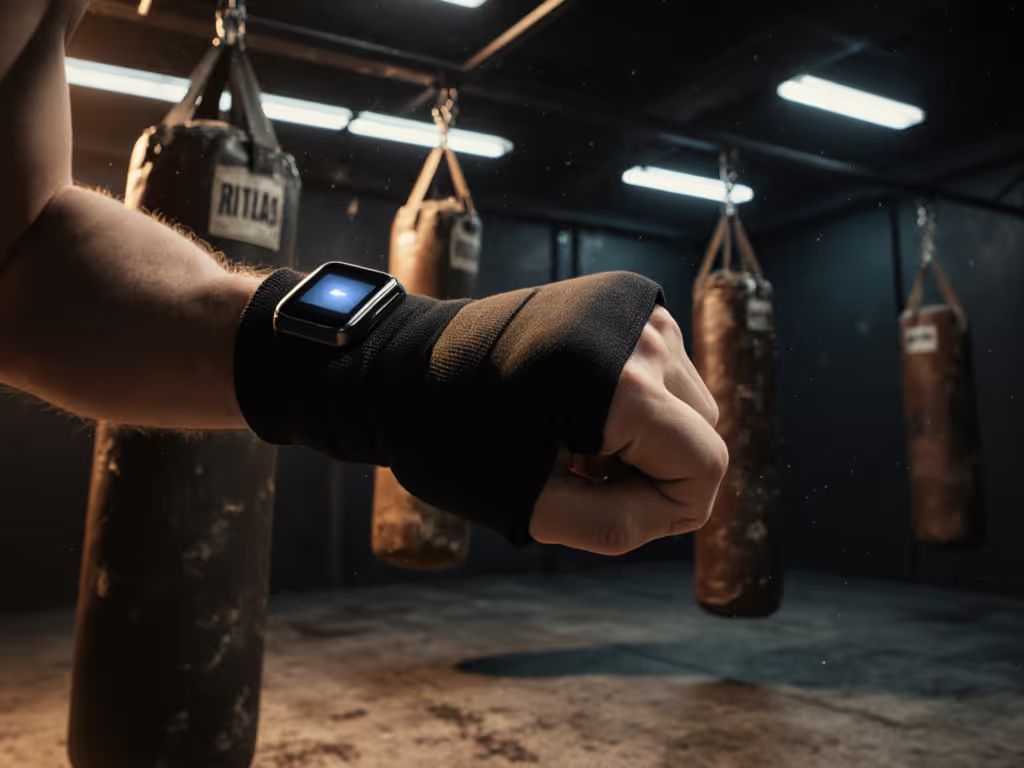
When you're sizing an opponent or timing a combination, your wrist needs to move. Ring fitness trackers promise to get out of the way (no bulky case, no strap friction) while still feeding you the data that matters: recovery, heart rate, readiness. But in combat sports, where metrics matter in real time, smaller sensors and discreet form factors come with real tradeoffs. I've spent enough time on mats and roads with multiple trackers on the same body to know that what looks clean in marketing looks different when you're working rounds or cutting weight. Here's what the research shows, what it misses, and what you can actually rely on.
Ring fitness trackers sit closer to the skin and use optical sensors (usually LED-based) to read heart rate and other signals from capillaries in your finger.[3] This is fundamentally different from wrist-based sensors. For a deeper dive into PPG tradeoffs by location, see our finger vs wrist HR accuracy explainer. The finger has denser blood flow, which sounds like an advantage, and in resting conditions it often is. But accelerometers (the motion sensors) built into rings are less precise than those in smartwatches.[4] For a boxer tracking hand speed or a wrestler monitoring impact load, that gap matters.
Rings also capture temperature continuously and can integrate HRV (heart rate variability) into sleep and recovery scoring. The Oura Ring Gen 4, for example, monitors 30+ signals including HRV, sleep stages, SpO₂, temperature, and stress, with up to 8 days of battery life.[2] That's a different rhythm than daily charging, one less friction point for adherence.
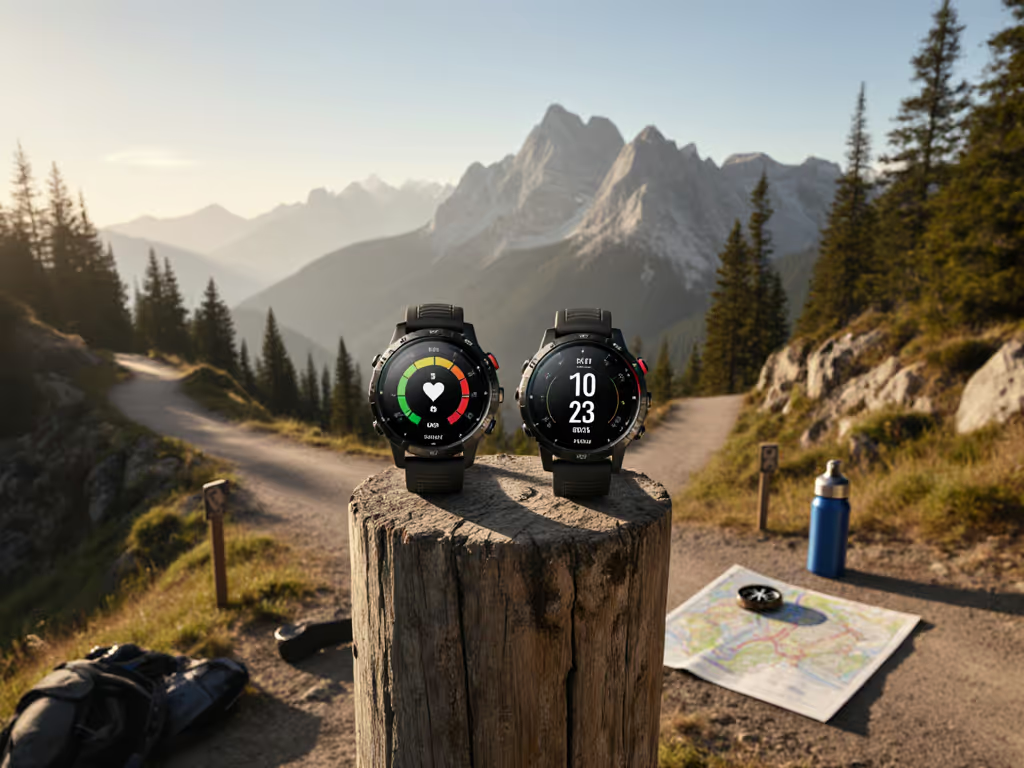
This is where I push back hardest. Heart rate accuracy at rest (±2 bpm compared to clinical-grade monitors) sounds solid on paper.[3] But "at rest" is not where fighters live. During high-intensity drills, rapid weight cuts, or sparring intervals, optical sensors on both rings and wrists can drift. I've watched a chest strap and a bicep optical sensor stay locked while two wrist-worn devices swung 15-20 bpm apart during headwind runs and when athletes turned into cooler air. Later, a darker-skinned runner showed stronger spikes under streetlights (an interaction between skin tone, ambient light, and optical noise I'd never quantified until I started mixed-protocol testing).
For rings, the finger is a smaller target. Your hand opens and closes during grappling, surface area changes, and pressure on the sensor changes with grip angle. A striking movement's demands (rapid acceleration, sudden force) create motion artifact that optical sensors struggle with, whether worn on wrist or finger. The specs don't tell you this. Field data does. We validated these effects across skin tones in our real-world sensor accuracy by skin tone comparison.
Expectation setting: If you're resting between rounds and want a snapshot HRV reading to assess readiness, ring trackers can do that reliably. If you want beat-to-beat accuracy during high-intensity intervals, you need a chest strap or an armband optical with a larger sensing window. Period.
This is where rings hit a real wall. Grappling activity recognition (detecting takedowns, positional changes, submission attempts) requires motion pattern detection. Smartwatches with 6-axis accelerometers can infer arm angle, rotation speed, and sustained pressure states reasonably well. Rings, with smaller accelerometers in a confined space, struggle.[4]
Oura Ring Gen 3 and Gen 4 track "workouts" when you log them manually or they auto-detect running and general movement.[2][3] But a jiu-jitsu session? A wrestling drill? You'll either get generic "activity" or you'll log it yourself. That's not the same as understanding what happened during those 20 minutes. For grappling activity recognition at scale (rep counts, pressure phases, postural load), rings are not yet the answer.
This is where rings shine. Recovery tracking for fighters is less about real-time metrics and more about overnight data: sleep stages, HRV trends, body temperature, stress hormones inferred from resting HR patterns. Oura Ring Gen 3 (priced at $299 plus membership) and the newer Gen 4 specifically target this use case (discreet wear, no strap chafing, water-resistant up to 328 feet).[2][3] That matters for the post-sauna cool-down or an ice bath.
But here's the caveat: sleep stage detection and recovery scoring are not transparent. Oura publishes equations and methods more openly than most, but "deep sleep," "REM," and "readiness scores" are still model outputs, not raw data you can cross-check yourself. Learn how to interpret readiness, Body Battery, and strain scores in our guide to decoding recovery metrics. If your sleep architecture is atypical (shift work, a new parent's fragmented sleep, or perimenopause patterns), the scoring may misread your actual recovery state. I've seen athletes dismissed as "well-recovered" when their actual training context showed otherwise.
Transparency move: Export your raw HRV and temperature data and compare trends with your coach or a simple moving average. Don't outsource your gut feel to an algorithm.
Heart rate spikes in martial arts are real, rapid, and noisy. Adrenaline, technical intensity, breath-holding during pressure, and rapid cooling post-round all create artifacts. Rings measure every one of them. The question is whether the device attributes those spikes correctly.
Wrist-based trackers have the same issue, but they benefit from larger accelerometers that can distinguish between physical effort and motion noise. Rings, with compact accelerometers, often misclassify sustained isometric work (a bottom position in grappling, a clinch in boxing) as low effort because there's minimal wrist acceleration. Your HR is 170, your body is under load, but the device may not weigh that signal correctly in its training load calculation.
For combat athletes, the lived outcome is this: use ring trackers for recovery and readiness signals (sleep, nighttime HRV, temperature) rather than as your primary training intensity monitor. If you're tracking conditioning, pair it with a chest strap or a smartwatch optical that handles high-intensity better.
Ring trackers require smartphone apps to view data and usually charge a subscription for advanced features and cloud storage. Oura Ring Gen 4 includes an upgraded app with personalized insights, but detailed analysis or export features often sit behind membership tiers.[2] That creates a hidden cost layer: the hardware price, then the annual subscription to actually use the data. See our fitness tracker subscription comparison for true long-term costs and what's locked behind paywalls.
Smartphone connectivity is another friction point. Rings don't receive text alerts or notifications (they're output-only devices).[2] For a fighter who wants to glance at data mid-session or get a recovery nudge before heading to the gym, that's limiting. You'll check your phone anyway, which defeats the minimalism pitch.
Data portability also varies. Some ring trackers sync to Apple Health or Google Fit; others keep data siloed. If you want to export raw CSVs or build your own analysis, ask the vendor directly (spec sheets rarely clarify this).
It depends on what you're optimizing. If your priority is overnight recovery metrics, minimal sleep friction, and you already own a reliable external tool for training intensity (chest strap, coach feedback, perceived exertion), a ring makes sense. The Oura Ring Gen 4 with its 30+ monitored signals and 8-day battery is a real upgrade from Gen 3.[2]
If you want all-in-one training and recovery tracking in one device, and you're willing to tolerate a wrist-worn form factor, a sports watch like the Garmin Forerunner 965 gives you deeper VO2 Max, lactate threshold, and conditioning insights for slightly more money and bulkier wear.[1]
The honest answer: in the wild, not the lab, I see fighters using rings as a secondary recovery layer alongside a smartwatch or chest strap for conditioning. That redundancy costs money, but it solves the accuracy problem. If you're buying your first device and budget is tight, choose the watch. If you already have a watch and want overnight insights that don't depend on wrist comfort, add a ring.
Asking the vendor for error bars (not just headlines) is the start. Specifically:
If a vendor can't or won't answer these, the device probably isn't validated enough for your needs.
Want to know if a ring tracker will work for you? Run a 3-4 week parallel test:
The best tracker is the one you'll actually wear and learn to interpret in real time. Shiny specs and athlete testimonials don't replace that ground truth. Your body and your training context are the final validation.
For deeper validation protocols, athlete case studies, and side-by-side error-rate comparisons of specific ring models in combat sports, consider reaching out to wearable testing communities or asking your coach to help you set up a simple parallel-wear protocol. Data is most trustworthy when it's your data, tested in your conditions.