Fitness Trackers for Gardening: Track Yard Work Right
19th Feb•9 min read
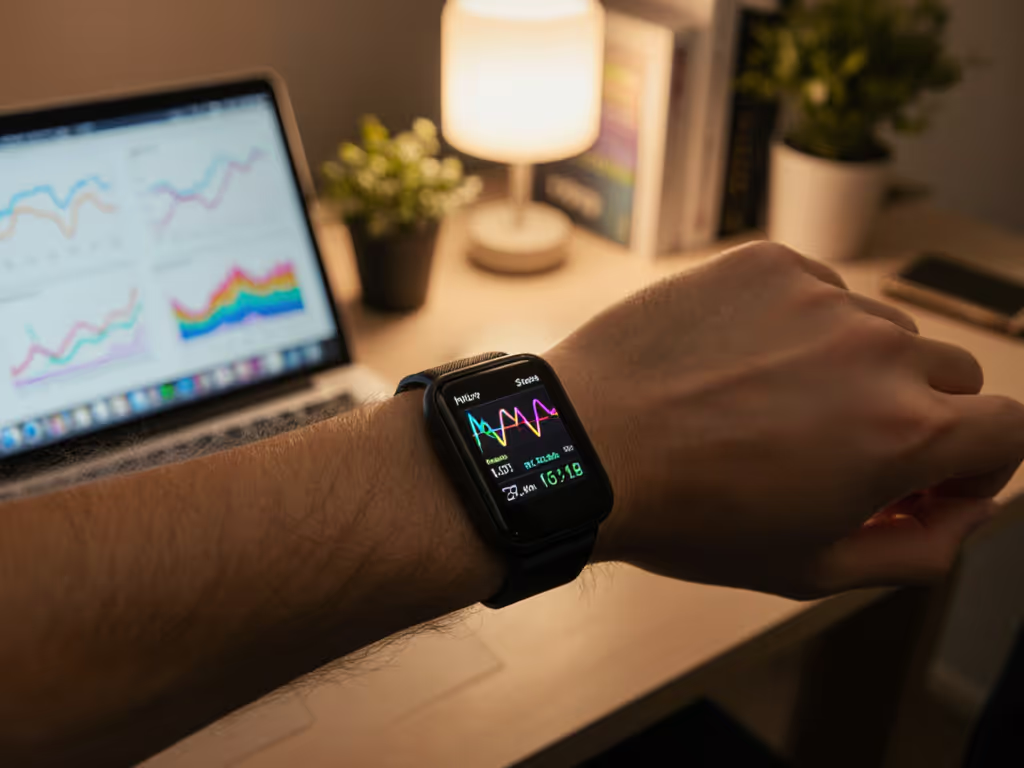
Your wrist device flashes a red "77" - high stress - but you feel calm. Then it shows "22" during a difficult afternoon. What's actually happening underneath fitness tracker stress metrics, and more importantly, should you trust what you see?
The short answer: these numbers measure something real about your body. The long answer (the one that matters) requires understanding what they measure, what they miss, and how to translate data into decisions you can actually act on. This guide cuts through the marketing and shows you the methods, limitations, and practical edge cases that trackers won't tell you.
Fitness trackers don't detect stress directly. They can't read your thoughts or feel your anxiety. Instead, they measure Heart Rate Variability (HRV), the tiny fluctuations in the time interval between heartbeats[2][4]. For a deeper primer on how wearables quantify stress through HRV, see our stress metrics validation guide.
When your body perceives a threat - whether that's a looming deadline or a hard sprint interval - your sympathetic nervous system ("fight or flight") activates. This tightens your heartbeat pattern, reducing variability. Conversely, during rest or calm focus, your parasympathetic nervous system dominates, and your HRV increases[2]. Your device's optical sensor detects these shifts and converts them into a stress score, typically on a 0-100 scale[3].
The methodology is sound. A recent validation study compared Garmin's stress score against electrocardiogram (ECG) data from a clinical-grade chest strap during both rest and mental-stress tasks[1]. Researchers found that Garmin's stress score did detect differences between stress and relaxation states, correlating significantly with heart rate and HRV metrics[1].
But here's where confidence, not certainty, matters: the same study also found that raw heart rate alone showed stronger association with subjective stress than the device's proprietary stress score[1]. The stress score added information, but it wasn't the whole story.
This is where most articles stop, but it's where real accuracy begins. Your stress score is influenced by far more than your emotional state.
HRV naturally varies by sex and baseline cardiovascular fitness[1]. Participants with low baseline HRV consistently showed higher stress scores than those with high baseline HRV, a difference of over 21 points in the validation study, even at rest[1]. Regular exercise and longer sleep duration both lowered stress scores independently[1]. Training effects, sleep debt, and body composition all modulate the signal.
This matters because it means two people in identical situations won't show identical stress numbers. A desk worker with high aerobic fitness and 7 hours of sleep might register a 35 during a tense meeting. A shift worker with 5 hours of fragmented sleep might hit 55 during the same meeting. Neither number is "wrong," but interpreting them without context is.
Optical sensors, the standard in wrist-worn trackers, rely on light penetration through skin to detect blood flow changes[4]. This introduces a source of measurement drift that most marketing glosses over: sensor placement, skin tone, tattoo coverage, and even ambient light all affect the reading[4].
I learned this the hard way during a winter group run. Two runners using optical wrist sensors saw stress scores spike erratically whenever we turned into headwinds, a physiological impossibility. Their devices were shifting on their wrists with each stride. A runner with darker skin tone showed stronger anomalies under streetlights, while a chest-strap baseline stayed steady. That night, I rewrote our validation protocol to test across skin tones, wrist sizes, temperatures, and movement types. Most manufacturers don't, and it shows when real users try to trust the numbers.
For best results, Garmin and similar devices recommend wearing the tracker during sleep, when movement is minimal[3]. During high-intensity exercise or outdoor activity (exactly when athletes want stress feedback) the signal is less reliable.
No[4]. For recovery-focused context on HRV changes, see our HRV for recovery accuracy explainer.
A tough workout, a difficult conversation, and a fever all raise sympathetic tone and lower HRV. Your device sees the physiological signature but not the source. An athlete who finishes a hard weight session and checks their stress score the next morning might see an elevated reading (reflecting recovery need, not anxiety). Conversely, someone experiencing genuine psychological stress might see a lower score if they slept well and exercised regularly, because those variables actively suppress the metric[1].
You provide the context. The device provides the signal. Conflating the two is where most users drift into misinterpretation.
The validation literature confirms that stress scores reliably detect changes in physiological state: stress vs. rest conditions show statistically significant differences[1]. On that measure, they work.
What they don't do is predict your subjective experience of stress with high fidelity. The same study found that the Garmin stress score demonstrated only marginal predictive value for how stressed a person actually felt, compared to the raw physiological metrics underneath[1].
Translation: the device is better at tracking your body's trend over time than at labeling today's score as "accurate" in an absolute sense. Use it as a tracker of your baseline and anomalies, not as a clinical diagnostic. The stress score range exists (0-25 resting, 26-50 low, 51-75 medium, 76-100 high)[3], but individual variance is large enough that your "50" may mean something different from someone else's "50".
Here's what you can actually do with this data:
Monitor your personal baseline. Track your typical daytime and nighttime stress score over 2-3 weeks in normal conditions. This becomes your reference. A deviation of 15+ points from your average suggests either a genuine stressor or a confounding variable (poor sleep, new workout intensity, illness) worth investigating.
Use stress scores to inform recovery decisions. Athletes can check HRV-based stress the morning after a hard session. If your score hasn't recovered toward baseline by the next day, your central nervous system is still taxed, a signal to prioritize easy movement, sleep, and nutrition over another intense session[2]. This is where the metric earns its place: not as a feeling report, but as a recovery checkpoint. To go beyond a single score, learn how to interpret readiness, Body Battery, and strain metrics alongside HRV.
Calibrate for your lifestyle. Night-shift workers, caregivers, and people with variable schedules often see elevated stress scores that don't reflect emotional distress: they reflect sleep fragmentation and circadian misalignment. If you work nights, our night-shift tracking guide shows how to adjust sleep and stress metrics for non-traditional schedules. Knowing this prevents false alarms. Similarly, if you're pregnant, experiencing hormonal changes, or taking new medications, your HRV baseline may shift. A higher baseline isn't failure; it's a signal to recalibrate your reference range.
Layer it with other signals. Stress score + resting heart rate + sleep duration + subjective mood create a more robust picture than any single metric. If your stress score is high but sleep is solid and you feel fine, check for device fit issues or recent exercise.
Wearable stress metrics remain unvalidated on diverse body types, skin tones, and movement patterns in real-world conditions. Research has typically happened in laboratory settings with controlled movement, exactly the opposite of when users actually use the devices. Female-specific physiology (menstrual cycle, pregnancy, perimenopause) significantly influences HRV, but most trackers use generic algorithms[1].
The stress score is also subject to the same confounding variables that plague all HRV-based metrics: caffeine, dehydration, time of day, posture during measurement, and ambient temperature all skew the result. A single high reading tells you almost nothing. A pattern of high readings, combined with context, tells you something.
Treat your stress metrics the way a serious experimenter would: as one data stream among many, with known sources of variance, edge cases you've personally identified, and clear methods for how the score was calculated. If your device won't tell you the methodology, that's a red flag, transparency should be standard.
Your tracker's stress score is not a clinical diagnosis, not a judgment of your emotional state, and not a reason to panic or self-medicate. It's a proxy for your autonomic nervous system's current posture, filtered through device placement, skin tone, recent activity, and sleep, variables that don't always align with how you feel.
Use it for trend spotting. Use it to inform training decisions. But remember: no number replaces your own sensory awareness. If your device says you're calm but your body says otherwise, trust your body first and use the data to ask "why?" rather than to override what you know about yourself.
The most useful metric isn't the highest stress score - it's the one you can explain and act on. Everything else is just noise waiting for context.