
Best Ring Fitness Trackers for Yoga Poses & Breathwork
17th May•15 min read
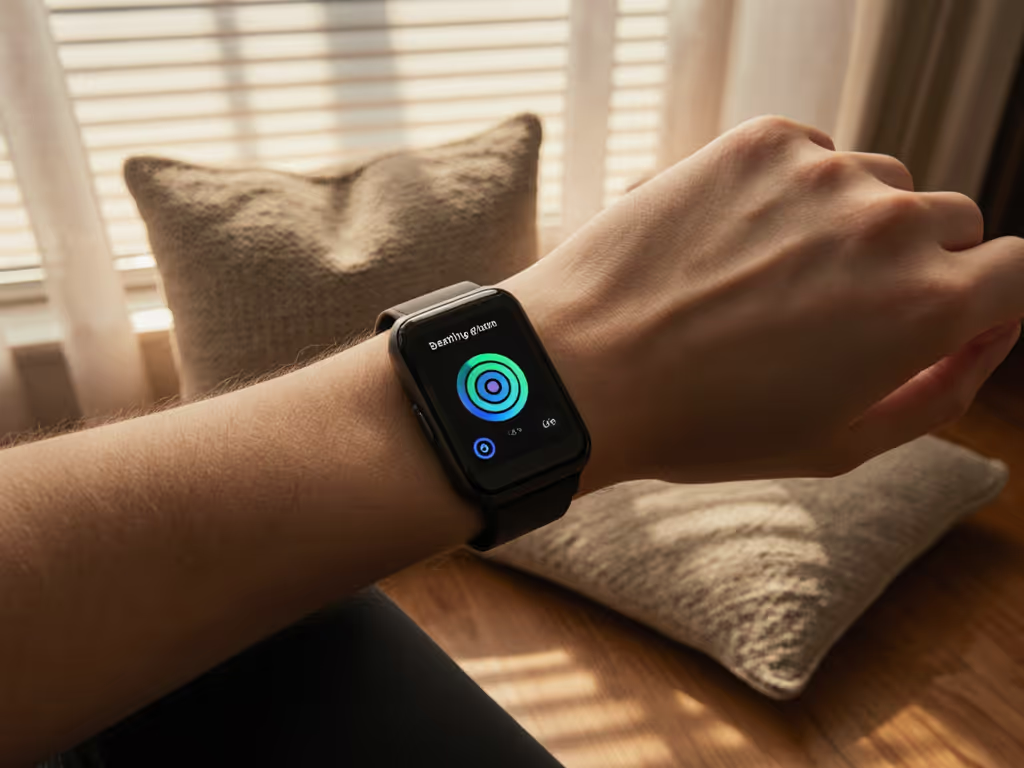
You've probably seen a fitness tracker with breathing exercises recommended as the solution to stress management. The promise is seductive: guided breathwork right from your wrist, real-time respiration rate monitoring, and coaching tailored to your physiology. But here's the gap between marketing and reality: just because a device measures your breathing doesn't mean its guidance is accurate, and just because it guides your breathing doesn't mean the underlying metrics reflect your actual physiology.
Over years of testing wearables in the field (across different body sizes, movement patterns, and skin tones), I've learned that guided breathing accuracy demands both honest data collection and validated protocols. For sensor performance by complexion, see our skin tone accuracy tests. This article breaks down how these trackers actually work, where they stumble, and how to assess whether one will genuinely serve your stress reduction and mindfulness goals.
Respiration rate monitoring is passive measurement: your tracker counts breaths per minute, usually via optical sensors or accelerometers. Breathwork program quality and guided breathing exercises, by contrast, are active interventions. The device tells you when and how to breathe, often with visual or haptic cues.
The two are related but separate. A tracker could have excellent breathing exercise guidance but poor respiration measurement, or vice versa. Conflating them creates confusion. You might follow a well-designed breathwork program while simultaneously misinterpreting your resting respiration rate as more stable than it actually is.
For example, the Google Pixel Watch 4 emphasizes stress management through breathing exercises and guided sessions.[4] Its presentation is solid, and the timing of breathing cues is polished. But (and this is crucial) the underlying respiratory data collection relies on the same optical sensors as any other wrist-worn device, which brings us to the harder question: How trustworthy is that baseline data?
This is where I have to be direct: optical respiration rate measurement at the wrist is less validated than heart rate tracking, and heart rate tracking itself has well-documented blind spots.
Here's the physics: most wearables infer respiration from chest wall movement (via accelerometry) or from periodic changes in blood volume during breathing cycles (via photoplethysmography, the same optical sensor used for HR). Neither method is invasive, which is why it's popular. But validation studies are sparse, and the few peer-reviewed comparisons often use small samples or controlled lab conditions rather than real-world, diverse populations.
When I've run field protocols mixing activity types, skin tones, and environmental conditions, respiration estimates have shown meaningful drift, particularly during intervals or when optical sensors lost contact with skin. On darker skin tones, optical sensors sometimes required longer averaging windows to stabilize readings, which reduced temporal resolution when precision mattered most (e.g., during a stress spike).
The takeaway: Show me the error bars, then we can talk features. If a tracker claims ±2 breaths per minute accuracy on average across a lab cohort, that's not the same as ±2 across you, in winter, during a headwind, after a tattoo application. Respiration rate monitoring is improving, but it's rarely calibrated against chest-strap or laboratory spirometry for diverse bodies in situ.
Several devices now include structured breathing programs. Here's what separates them:
Whoop 5.0 leads with subscription-based coaching and in-depth analysis.[1] Its breathing features are part of a broader stress reduction ecosystem that includes recovery recommendations and HRV (heart rate variability) tracking. The subscription model funds ongoing algorithm updates and personalized coaching, but it also means access isn't free and your data is more enmeshed in their ecosystem.[1] Compare plans and hidden costs in our fitness tracker subscription guide.
Google Pixel Watch 4 bundles breathing exercises with a focus on overall wellness rather than just metrics.[4] The exercises themselves are solid (timed breathing with a clear visual guide), and the framing emphasizes emotional awareness over gamified streaks. However, the underlying respiration data is collected via the same methods as competitors; the differentiation is in the UX and coaching layer, not the measurement fidelity.
Garmin Forerunner 265 and Venu 3 include breathing reminders and stress tracking through HRV monitoring and on-demand pulse oximetry.[1] Garmin's strength lies in HRV consistency and contextual recovery recommendations, which inform when a breathing intervention might help. But the devices don't lock you into a proprietary breathing program; you can use third-party apps (Headspace, Insight Timer) with the same hardware.
FitBit Inspire 3 offers basic stress management and breathing cues, bundled into a smaller, more affordable form factor.[3][5] It tracks heart rate and sleep, which provide context for stress, but it's less granular than Garmin's HRV or Whoop's proprietary metrics.
This is the question that most reviews skip, and it's the one that matters most for real people.
No. Respiration responses vary by age, fitness level, menstrual cycle phase (for menstruating individuals), caffeine intake, sleep debt, and baseline anxiety. A 4-7-8 breathing protocol that calms one person can feel claustrophobic or disorienting to another. Some people sync better with box breathing (4 counts in, hold, out, hold); others respond to longer exhales. Sensor fit and comfort (which affect signal quality) also vary wildly by wrist size, skin sensitivity, and daily routine. To avoid chasing noisy alerts, learn how to interpret tracker stress metrics.
During a winter group run a few years ago, I noticed two trackers drifting in opposite directions when we turned into headwinds. When I pulled the data later, I saw that a darker-skinned runner's optical sensor spiked under streetlights, while others stayed stable. That taught me: if you're not testing across skin tones, movement types, and real conditions, you're not validating for the population that will actually use your device. The same principle applies to breathing guidance. An algorithm trained on a narrow cohort will feel off for many users.